

“Should we use WordPress or Shopify?” It’s one of the questions we’re asked most, and most articles answer it with a giant feature table that leaves you more confused than before.
Here’s the honest answer: neither is better. They’re built for different jobs. The right choice depends on what your website mainly needs to do.
The one-sentence version
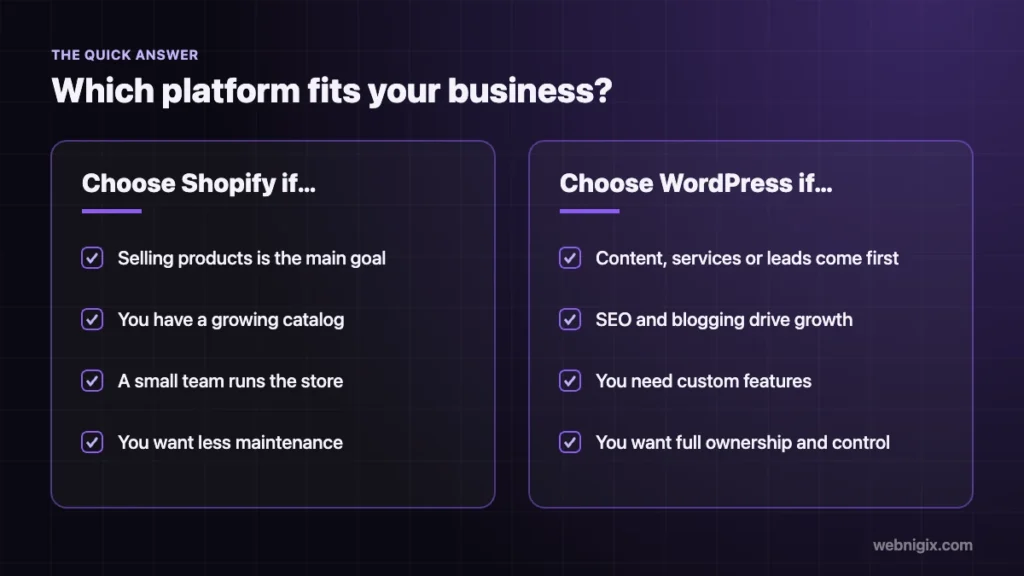
- Choose Shopify if selling products online is the main point of your website.
- Choose WordPress if your website is mainly about content, services, leads or flexibility, with selling as one part of it (or not at all).
If that settles it for you, great. If not, read on.
What Shopify does brilliantly
Shopify is a hosted eCommerce platform. You pay a monthly subscription and Shopify handles the hosting, security, payments infrastructure and checkout.
- The checkout is excellent and trusted by shoppers, which matters for conversion.
- Running a store is simple: products, inventory, orders, discounts and shipping are all built in and easy for non-technical teams.
- Less to maintain: no server updates, no core software patches.
- A huge app ecosystem for reviews, subscriptions, upsells, email marketing and more.
Where Shopify can frustrate you
- Costs add up: subscription, paid apps, premium themes and, depending on your payment setup, transaction fees.
- Less control: you work within Shopify’s structure, including its URL patterns and checkout rules.
- Content is secondary: the blog and page tools are basic compared with WordPress.
What WordPress does brilliantly
WordPress is open-source software you install on your own hosting. It powers a huge share of the web, from simple brochure sites to large publications.
- Total flexibility: almost any layout, feature or integration is possible.
- Content and SEO strength: blogs, guides, landing pages and fine-grained SEO control with tools like Yoast.
- You own everything: your site, your data, your hosting choice.
- eCommerce when you need it: WooCommerce turns WordPress into a capable store.
Where WordPress can frustrate you
- Maintenance is your job: updates, backups, security and hosting all need looking after.
- Plugin sprawl: too many plugins can slow a site down or cause conflicts.
- Quality varies: a well-built WordPress site is fast and solid; a badly built one is the opposite.
A simple way to decide
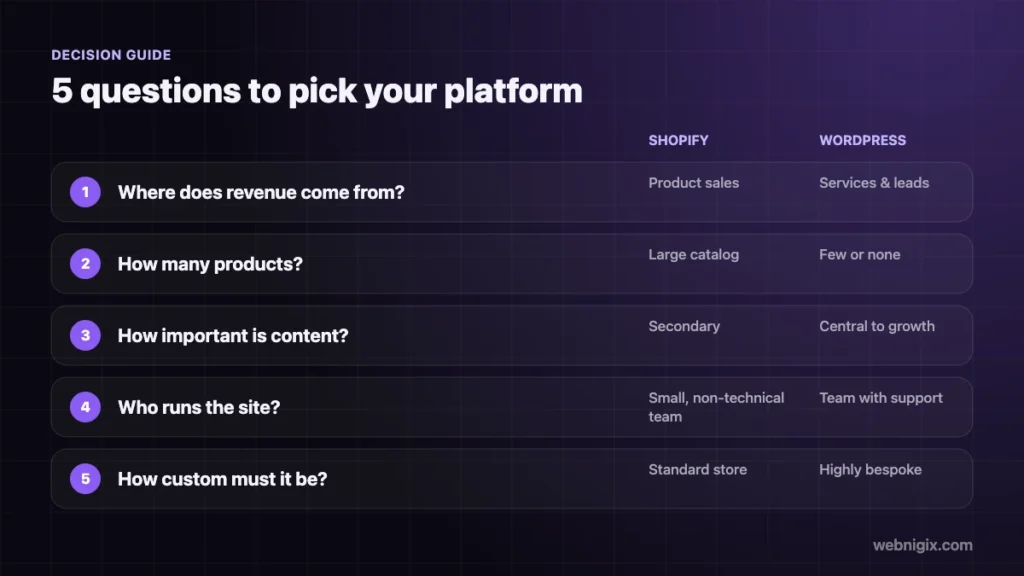
Answer these five questions:
- Where does most of your revenue come from? Online product sales point to Shopify. Services, leads or bookings point to WordPress.
- How many products do you sell? A large or growing catalog with variants and inventory favors Shopify.
- How important is content? If blogging, guides and SEO are central to your growth, WordPress has the edge.
- Who will run the site day to day? A small non-technical team often finds Shopify easier to live with.
- How custom does it need to be? Unusual features, complex integrations or a highly bespoke experience usually favor WordPress.
What about using both?
Some businesses run a content-rich WordPress site alongside a Shopify store, or embed Shopify’s Buy Button in WordPress. It can work well, but it adds complexity, so it’s best when there’s a clear reason for it.
The mistake to avoid
The most expensive choice is the one you have to undo. Migrating platforms later means redesigning, moving data and setting up redirects to protect your search rankings. Spending an hour on this decision now can save months later.
Still torn? We build on both. See our WordPress development and Shopify development services, or tell us about your project and we’ll give you a straight recommendation.
Need help with your website? Talk with Webnigix about your project.